
Every openEHR endpoint, one desktop app
ehr-ctrl is a friendly interface to the openEHR REST API for openEHR clinical data repositories — EHR, compositions, templates, stored queries, and more — so you're not hand-writing HTTP requests just to see what's in your CDR.
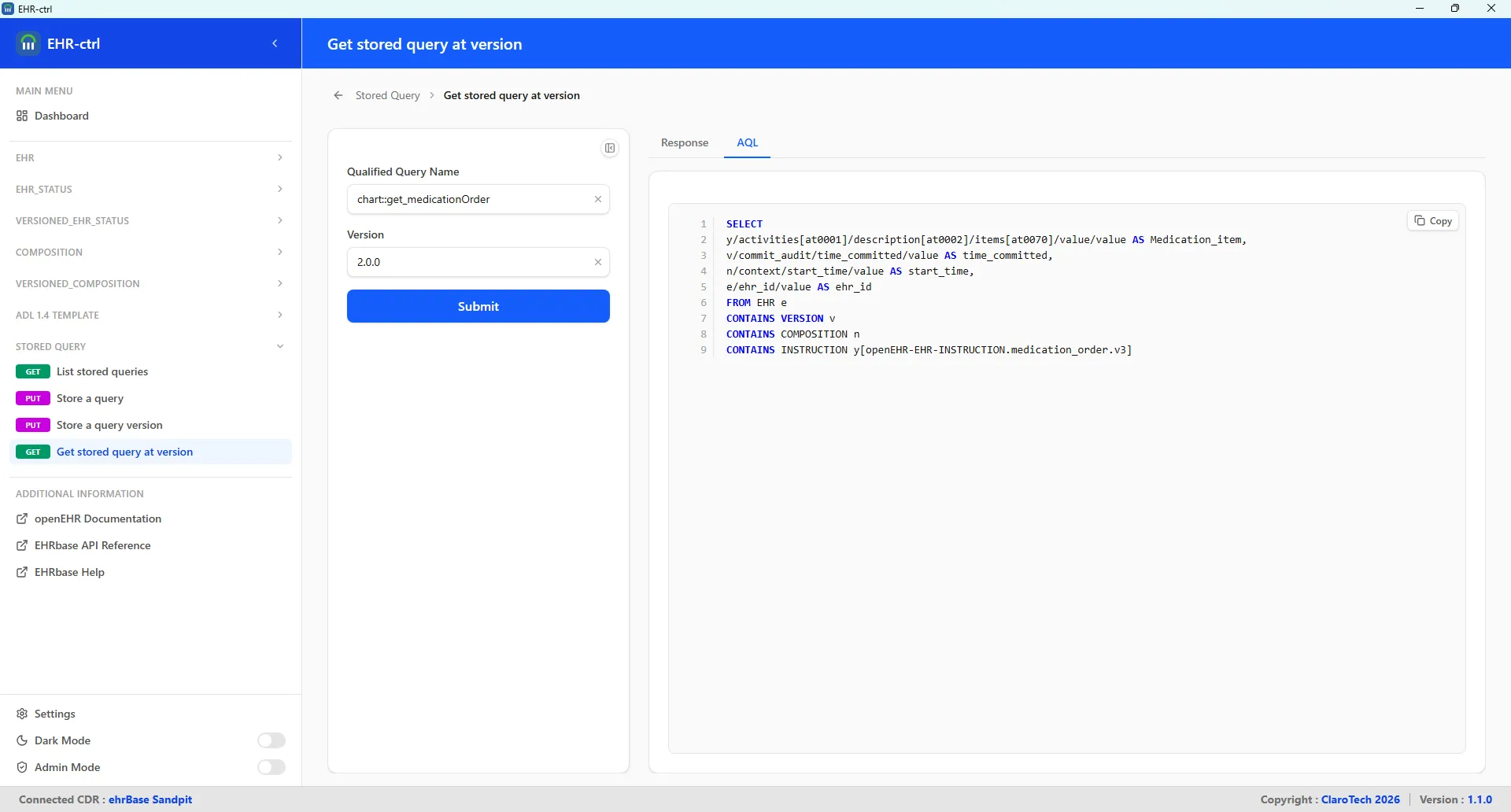
Full openEHR REST API coverage intended
EHR, EHR_STATUS, DIRECTORY, COMPOSITION, and CONTRIBUTION endpoints — create, retrieve, update, and delete resources through guided forms instead of hand-built HTTP calls.
Versioned resource history
VERSIONED_EHR_STATUS and VERSIONED_COMPOSITION support let you retrieve any resource at a specific time or version without chaining the calls yourself.
AQL query workbench
Write and run ad-hoc AQL, or execute a STORED_QUERY definition, with Table, JSON, and AQL views of every result set. Save your queries for later, and export results to CSV for further analysis.
Template management
List, inspect, and upload or download ADL 1.4 templates deployed to your CDR, and generate example compositions straight from a template.
Multiple CDR connections
Save connections to local Docker instances or hosted openEHR servers, and switch the active one from Settings. Credentials are stored locally on your device, not sent to us.
Request & response diagnostics
Every call surfaces its method, URL, headers, and duration alongside the response — useful when debugging your own integration against the same API.
Deployment model
Desktop app
Installs and runs on your machine. You point it at your own openEHR instance — nothing about your clinical data passes through us.
Built for standards
Implements the openEHR REST API the way EHRbase, FerroEHR, and other vendors expose it, including the stored-query and template endpoints.
Operational focus
Designed for querying, validating, and administering data that already exists in your CDR — not for clinical data entry.